
Overpriced Listings: How Estate Agents Can Win the Mandate Without Buying the Listing
Every property practitioner eventually encounters this conversation.
You have inspected the property.
You have researched the area.
You have reviewed recent sales.
You have looked at what competing properties are asking.
Everything points towards a realistic selling range of approximately R2.2 million to R2.3 million.
Then the seller looks at you and says:
“I want R2.7 million.”
To make matters worse, another agent has apparently already told them that R2.7 million is achievable.
Now you have a decision to make.
Do you challenge the seller's expectation and potentially lose the mandate?
Or do you agree with the R2.7 million price, secure the listing and worry about the price reduction later?
The second option can be very tempting.
But this is where many property practitioners make one of the most damaging mistakes in residential real estate:
They buy the listing.
Winning a mandate should never require abandoning your professional judgement.
The objective is not simply to get the listing.
The objective is to get the property sold while maintaining the seller's trust throughout the process.
And that requires a very different pricing conversation.
Why Do Sellers Overprice Their Properties?
The first mistake an agent can make is assuming that an unrealistic seller is simply being difficult.
There is normally a reason behind the number.
Your job is to find it.
Before trying to correct the seller's price, understand where the price came from.
1. Emotional Value vs Market Value
A seller does not view their property through the same eyes as a buyer.
The seller remembers:
Raising their children in the home
Renovating the kitchen
Installing new flooring
Building the entertainment area
Improving the garden
Spending hundreds of thousands of rands on upgrades
Years of memories associated with the property
To the seller, those things have enormous value.
A buyer sees something different.
The buyer sees:
“What else can I buy for R2.5 million?”
That is one of the biggest differences between emotional value and market value.
You do not need to dismiss the seller's attachment to the property.
In fact, you should acknowledge it.
But your responsibility as the property practitioner is to help the seller separate what the home means to them from what buyers are currently prepared to pay for it.

2. Sometimes the Seller “Needs” a Certain Price
Another common situation has very little to do with valuation.
The seller may say:
“I need R2.5 million.”
The important word is need.
Perhaps the seller needs a certain amount after settling their bond.
Perhaps they need enough money for the deposit on their next property.
They may be relocating.
They may have debt they want to settle.
Or they may simply have built their next financial decision around receiving a particular amount from the sale.
Those financial requirements are important.
But they do not determine the property's market value.
The market does not ask:
“How much money does the seller need?”
It asks:
“Compared with everything else available, what is this property worth to me?”
This is why one of the most valuable questions you can ask during a listing presentation is:
“How did you arrive at the price you have in mind?”
Then stop talking.
Listen.
The answer will often tell you exactly what you need to deal with next.
3. “My Neighbour Sold for More”
You will hear this regularly:
“The house around the corner sold for R3 million, and my house is better.”
Maybe it is.
But maybe the other property had:
A larger stand
More bedrooms
Additional bathrooms
Better renovations
Solar and backup power
A swimming pool
A double garage
A better position inside the estate
Superior views
More modern finishes
A larger floor area
Or perhaps it sold six months ago under completely different market conditions.
Comparable sales are valuable only when the properties being compared are genuinely comparable.
This is where the agent moves away from opinion and towards evidence.
Stop Making Pricing Personal
One of the biggest improvements a property practitioner can make to a listing presentation is changing the pricing conversation from:
Seller vs Agent
to:
Seller + Agent vs Market Evidence
Instead of saying:
“I don't think your property is worth R2.7 million.”
Try:
“Let's look at what buyers have actually been paying for similar properties.”
Notice the difference.
You are no longer positioning yourself as the person preventing the seller from getting their price.
You are positioning yourself as the professional helping the seller interpret the market.
That is a far stronger position.
Use Data to Anchor the Seller in Reality
When pricing becomes emotional, data gives the conversation structure.
South African property practitioners can use resources such as Lightstone, TPN, recent registered sales, area comparables, their own agency transaction records and current competing listings to build a clearer picture of the market.
Your presentation should help the seller understand three very different numbers.
1. What Sellers Are Asking
These are the prices currently advertised online.
They are useful because they show your competition.
But remember:
An asking price does not prove market value.
A property can be advertised at R3 million for six months without receiving an acceptable offer.
2. What Buyers Are Responding To
Look at buyer behaviour.
Which properties are generating enquiries?
Which price brackets are attracting qualified buyers?
What feedback are buyers giving after viewings?
What alternatives are those buyers considering?
This information becomes extremely valuable once your listing is live.
3. What Properties Have Actually Sold For
This is where the conversation becomes considerably more meaningful.
A comparable property listed at R2.8 million provides some information.
A comparable property that actually sold for R2.4 million provides different information.
The second number reflects an actual agreement between a willing seller and buyer.
Tools such as Lightstone can provide sales history and comparable-sales information, while TPN property valuation reports include information such as transaction history, comparable sales, area trends and estimated property values.
Use the tools available to you, but always combine the report with your professional understanding of the actual property.
A report cannot walk through the house.
You can.

The Danger of “Buying the Listing”
Buying the listing happens when an agent knowingly agrees with an unrealistic asking price primarily because they want the mandate.
The thought process normally goes something like this:
“Let me take it at R2.7 million. Once the seller signs the mandate, I'll convince them to reduce it later.”
It sounds clever.
Until the property has been sitting on the market for six weeks.
Then the seller starts asking:
“Why haven't you sold my property?”
Now you have a problem.
Six weeks ago you told them R2.7 million was achievable.
Today you are telling them they need to reduce it to R2.3 million.
The seller may understandably ask:
“Then why did you tell me R2.7 million in the first place?”
And suddenly this is no longer a pricing problem.
It is a credibility problem.
Overpricing Can Hurt the Property's Marketing
Price is not something that sits separately from your marketing strategy.
Price is part of the marketing strategy.
Imagine the property is realistically competing around R2.2 million.
You list it at R2.65 million.
A buyer searching online with a maximum budget of R2.4 million may never even see your listing.
Meanwhile, the buyers who do see the property at R2.65 million are comparing it with properties legitimately competing in the R2.6 million price range.
Your listing may suddenly look like poor value.
That can result in:
Fewer qualified enquiries
Fewer viewings
Weak buyer interest
Longer days on market
Repeated price reductions
Reduced negotiating leverage
Seller frustration
A stale listing
In certain situations, chasing an unrealistic price can ultimately contribute to the seller achieving less, not more.
A Step-by-Step Pricing Conversation Framework for Property Practitioners
So how do you tell a seller that their price is unrealistic without destroying your chances of winning the mandate?
Try this framework.
STEP 1: Let the Seller Speak First
Before showing your valuation, ask:
“What price did you have in mind?”
Then ask:
“How did you arrive at that figure?”
This second question is arguably more important than the first.
You are identifying whether their expectation comes from:
Another agent
A neighbouring sale
Their outstanding bond
Renovation costs
Their next purchase
Online research
Emotional attachment
Genuine market evidence
You cannot properly handle the price objection until you understand the belief behind it.
STEP 2: Validate Before You Educate
If the seller says R2.7 million and your research suggests R2.3 million, do not immediately respond:
“That's far too high.”
You have just created an argument.
Instead:
“I can understand why you would want to achieve that figure, particularly considering the improvements you've made to the property.”
Then transition:
“What I'd like us to do is compare that expectation with what buyers have actually been paying for similar properties.”
Now you are working together.
STEP 3: Show the Evidence
Ideally, structure the evidence into three groups.
Recently Sold
What did comparable properties actually sell for?
Currently Competing
What other homes will your seller be competing against today?
Previously Overpriced
Where possible, demonstrate what happened to properties that launched significantly above the market and later had to reposition.
Do not overwhelm the seller with 40 comparables.
Choose the evidence that tells the story most clearly.
STEP 4: Put the Seller in the Buyer's Shoes
This can completely change the conversation.
Suppose the seller wants R2.7 million.
Show them three or four other properties available between approximately R2.5 million and R2.7 million.
Then ask:
“If you were the buyer with R2.7 million to spend, which of these properties would you choose?”
Do not answer for them.
Let them think.
You are helping the seller see their property through the eyes of the person who ultimately has to write the cheque.

STEP 5: Recommend a Range Before a Number
Property valuation is not always an exact science.
Rather than declaring:
“Your house is worth exactly R2,250,000.”
Consider:
“Based on the comparable evidence, current competition and the condition of the property, I believe the strongest market range is approximately R2.2 million to R2.35 million.”
Then explain your recommended launch position.
For example:
“I would recommend launching at R2.295 million. That keeps us competitively positioned while still creating some room for negotiation.”
Now the seller understands the strategy behind the number.
STEP 6: Explain That Your Job Is Not to Give the Highest Valuation
This conversation requires confidence.
You can say:
“I would love the opportunity to represent you, but I don't want to win your mandate by simply giving you the highest number. My responsibility is to give you the strategy I genuinely believe provides the strongest opportunity of achieving the best possible result.”
That is a very different sales pitch.
You are no longer competing to be the agent who promises the most.
You are competing to be the agent the seller trusts most.
Want to Become Better at Conversations Like These?
Knowing how to value property is important.
Knowing how to communicate that valuation to a seller is what separates information from skill.
The best property practitioners continuously sharpen their ability to prospect, present, negotiate, handle objections and manage sellers through difficult conversations.
If you are looking for an environment where you can build your real estate career while being part of a business that values trust, integrity, transparency and value, explore the opportunity to become a Property Practitioner with THABCO PROPERTIES.
Build Your Real Estate Career With THABCO PROPERTIES
Ready to grow as a Property Practitioner? Join a real estate business focused on building capable, professional and results-driven practitioners.
What If the Seller Still Insists on the Higher Price?
This is important:
An unrealistic seller does not automatically mean you must walk away from the mandate.
There may be situations where you are prepared to test a slightly more ambitious price.
But do it strategically.
Instead of simply saying:
“Okay, let's list at R2.6 million.”
Establish the review process before the mandate is signed.
For example:
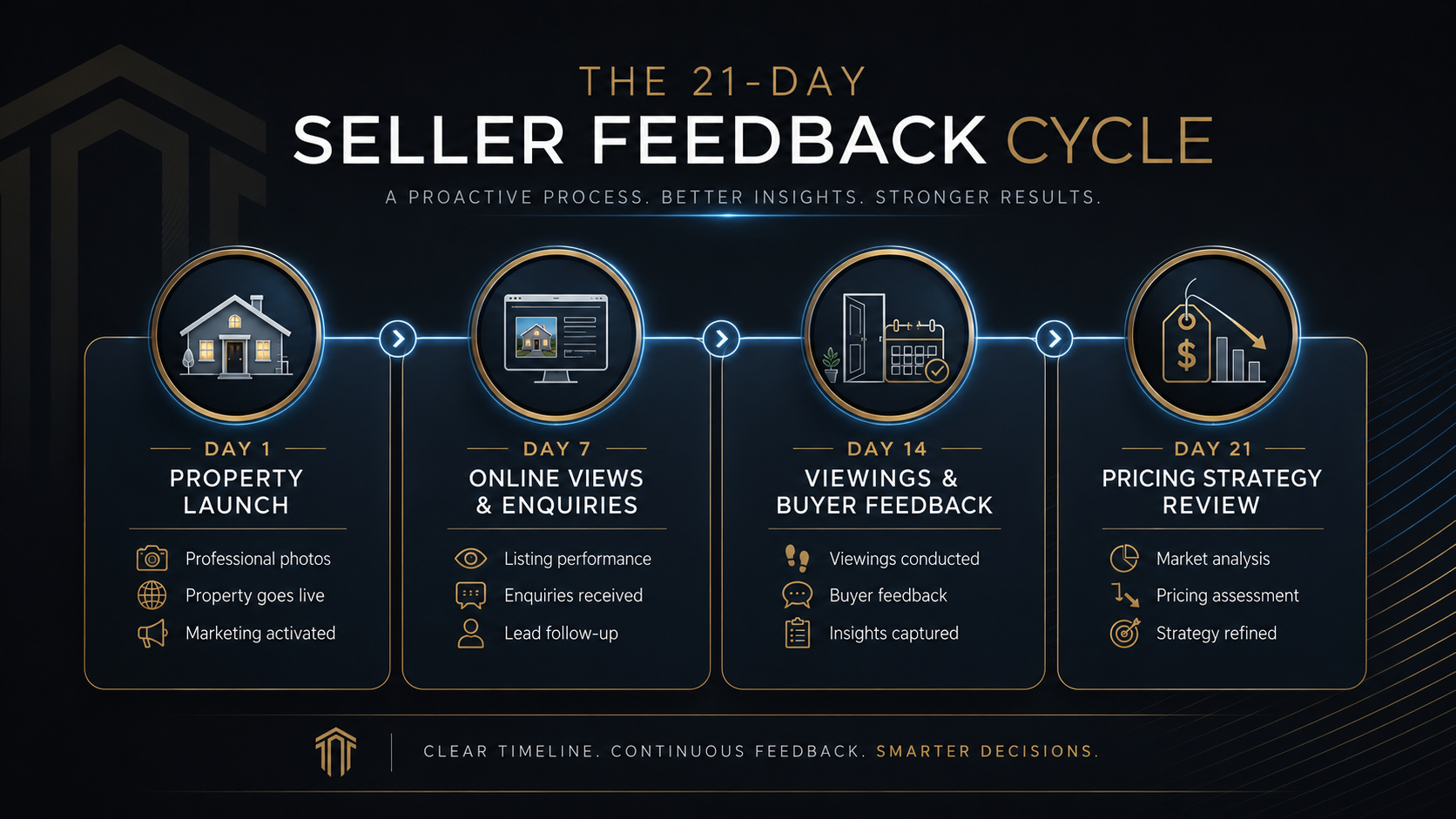
“I understand that you would like us to test R2.6 million. We can launch there, provided that we agree upfront to review the market response after the first 14 to 21 days.”
Now define what you will measure.
For example:
Listing views
Enquiries
Qualified enquiries
Viewing requests
Completed viewings
Buyer feedback
Offers received
New competing listings
Competing properties that have sold
Changes in buyer activity
Now you have transformed a disagreement about price into a measurable strategy.
Don't Wait Until You Need a Price Reduction
This is where seller management becomes critical.
Do not disappear after taking the mandate.
And definitely do not disappear for six weeks before suddenly calling the seller and saying:
“We need to drop the price.”
By then, the seller may believe that the problem is you.
Instead, establish regular feedback from the beginning.
Week 1
You might report:
“We launched strongly and generated 1,150 property views, 18 enquiries and four viewing requests.”
No price conversation is necessary yet.
You are simply reporting the market.
Week 2
Perhaps:
“We have now completed six viewings. Four of the buyers independently indicated that they felt the property was priced above comparable alternatives they are considering.”
Again, you are reporting information.
Week 3
Perhaps:
“A competing property at R2.3 million has now received an offer, while enquiry activity on our listing has slowed considerably.”
Now you can revisit the strategy.
How to Reduce the Asking Price Without Losing the Seller's Trust
The words you use matter.
Avoid:
“Your house is overpriced. We need to drop the price.”
Try:
“We've now gathered enough market feedback to evaluate our original strategy.”
Then show the evidence.
Original Asking Price
R2,595,000
Days on Market
21
Qualified Enquiries
12
Viewings
7
Offers
0
Consistent Buyer Feedback
Priced above comparable alternatives
Recommended Repositioning
R2,395,000
Then explain:
“Based on the response we've received, I recommend repositioning the property to R2.395 million. This moves us into a stronger buyer search range and makes us more competitive against the properties buyers are currently choosing.”
Notice what you did not say.
You did not say:
“I was wrong.”
And you did not say:
“You were wrong.”
You said:
“The market has given us new information. Let's respond to it.”
That is professional seller management.
Use Your AI Real Estate Agent Coach Before the Conversation
Pricing presentations, seller objections and mandate conversations are difficult to improve through theory alone.
Sometimes the best preparation is to practise the conversation before you are sitting across from the seller.
That is exactly where the AI Real Estate Agent Coach can become useful.
Before your next listing appointment, use the coach to:
Practise handling an overpriced seller
Role-play difficult listing objections
Test different responses
Prepare questions for the seller
Sharpen your pricing presentation
Work through negotiation scenarios
Improve your confidence before the appointment
You can even give the AI Coach a scenario such as:
“I'm meeting a seller tomorrow. My valuation is R2.3 million, but the seller wants R2.7 million because another agent promised that price. Role-play the seller and challenge me until I can confidently explain my pricing recommendation.”
That turns preparation into practice.
Practise the Conversation Before You Have It
Use the AI Real Estate Agent Coach to practise objections, listing presentations, prospecting conversations and real-world scenarios before you face them with a client.
START USING THE AI REAL ESTATE AGENT COACH

The Agent Who Says “Yes” to Everything Is Not Always the Best Agent
There will almost always be another property practitioner willing to tell the seller:
“Absolutely. We can get R2.7 million.”
You cannot control that.
What you can control is the quality of your advice.
You should be confident enough to tell a seller:
“I would rather risk losing the mandate by giving you honest advice than win your mandate by making a promise the market evidence does not support.”
That statement will not win every listing.
It shouldn't.
You do not need to win every listing.
You need to build a reputation for giving advice that sellers can trust.
Your Responsibility Is Not to List Properties. It Is to Sell Them.
There is an important distinction.
Anyone can upload a property onto a portal.
Professional property practitioners do much more.
They:
Analyse the market
Position the property correctly
Create demand
Qualify buyers
Manage expectations
Communicate feedback
Negotiate strategically
Protect the seller's interests
Adapt when the market responds differently than expected
That is the real value of the practitioner.
Final Takeaway: Don't Buy the Listing. Earn the Mandate.
Overpriced listings are rarely solved by arguing with sellers.
They are solved by having better conversations.
Start by understanding why the seller wants their price.
Separate emotional value from market value.
Use credible property data and comparable evidence.
Show the seller what buyers are seeing.
Explain the strategy behind your recommended price.
Agree on a review process before launching at an ambitious price.
Communicate consistently after the property goes live.
And when a price adjustment becomes necessary, use market evidence rather than blame.
Most importantly:
Never sacrifice your professional credibility simply because you are afraid of losing the mandate.
The purpose of a listing presentation is not to tell the seller the number they most want to hear.
It is to demonstrate that you are the property professional they can trust to guide them from listing to SOLD.
READY TO TAKE YOUR REAL ESTATE CAREER FURTHER?
Whether you are building your career as a Property Practitioner or simply want to sharpen the skills you already have, growth comes from continuously improving the conversations that create business.
Want to grow your career with THABCO PROPERTIES?
Become part of a real estate business built around value, trust, integrity and transparency.
JOIN THABCO PROPERTIES AS A PROPERTY PRACTITIONER
Already working in real estate?
Practise your prospecting, objection handling, listing presentations, negotiations and seller conversations with the AI Real Estate Agent Coach.
START USING THE AI REAL ESTATE AGENT COACH
FAQ: Overpriced Property Listings
What does “buying the listing” mean in real estate?
Buying the listing refers to a situation where a property practitioner agrees with or suggests an unrealistically high asking price primarily to convince the seller to award them the mandate, often intending to request a price reduction later.
How do you tell a seller their property is overpriced?
Avoid making it a confrontation between your opinion and theirs. Ask how they arrived at their price, acknowledge their reasoning and then compare their expectation with relevant comparable sales, current competing properties and buyer behaviour.
Should an estate agent accept an overpriced listing?
It depends on the circumstances. If the seller understands the market evidence and both parties agree to test a higher price for a defined period with a predetermined pricing review, the listing may still be workable. Avoid accepting a price you know is unrealistic without discussing the risks with the seller.
How long should you wait before reducing a property's asking price?
There is no single period that applies to every property. Rather than relying exclusively on time, assess enquiry volumes, viewings, buyer feedback, competing listings and offers. A 14-to-21-day initial review can provide a useful checkpoint in active markets, but the appropriate strategy depends on the property and local conditions.
What information should agents use when pricing a property?
Consider recent comparable sales, current competing listings, property condition, location, size, features, current buyer demand and credible property-data sources such as Lightstone and TPN. Data should support—not replace—the property practitioner's professional judgement.
Why can an overpriced property take longer to sell?
An unrealistic asking price may place the property outside relevant buyer search brackets or force it to compete against superior properties available at the same price. This can reduce qualified enquiries, viewings and offers.
How can a property practitioner convince a seller to reduce their price?
Regular communication is critical. Instead of suddenly requesting a reduction, provide the seller with measurable market feedback throughout the mandate. When sufficient evidence exists, position the adjustment as a strategic response to the market rather than an admission of failure.


